

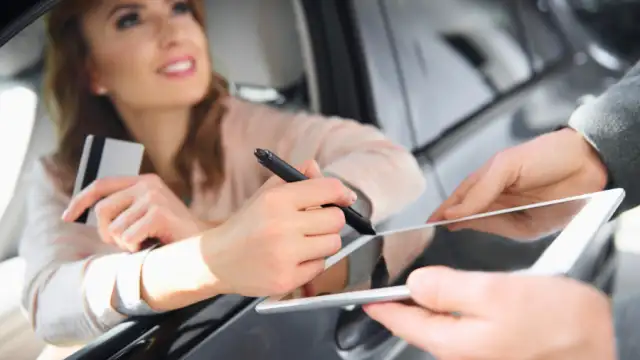
Buying a car with a credit card may sound like an easy way to earn thousands of points or avoid taking out an auto loan.
In reality, whether you can pay for a car with a credit card depends largely on the dealership, your credit limit, and the card issuer.
Some dealers accept credit cards only for a down payment or a limited portion of the purchase price. Others may allow a larger transaction, sometimes with an additional fee. Before reaching for your card, it is worth calculating the real cost.
Can you buy a car with a credit card?
Yes, you can buy a car with a credit card if the dealership accepts the payment and your available credit is high enough.
However, dealerships are not required to accept credit cards for vehicle purchases, and many set their own limits because card transactions come with processing costs.
For example, a dealer might allow you to put:
- A deposit on a credit card
- Part of the down payment on a card
- Several thousand dollars of the purchase price on a card
- The entire vehicle price on a card in less common situations
The key is to ask about the dealership’s credit card payment policy before negotiating the final payment method.
Why do some car dealers limit credit card payments?
Every time a merchant accepts a credit card, it generally pays fees associated with processing the transaction.
On a small purchase, that cost may be manageable. On a vehicle costing tens of thousands of dollars, however, the expense can become much larger.
That is why a dealership may:
- Set a maximum credit card payment
- Accept cards only for deposits or down payments
- Add an allowed processing or surcharge fee
- Refuse credit cards for the vehicle purchase altogether
Policies can vary even between dealerships belonging to the same automotive brand.
Can you make a car down payment with a credit card?
Often, yes.
Using a credit card for a car down payment is more common than charging the entire vehicle because the transaction is smaller.
Still, dealer policies vary. One dealership might accept several thousand dollars on a card, while another may allow only a small deposit.
Before doing this, make sure the credit card balance will not become expensive debt. A down payment is supposed to reduce the amount you need to finance, not replace part of an auto loan with potentially higher-cost revolving debt.
Is it smart to buy a car with a credit card?
It can make sense in limited circumstances, particularly when you already have the cash available to pay the card balance in full.
It becomes much riskier when the card is being used because there is not enough cash to cover the vehicle.
The main factors to consider are:
Your credit card APR
Credit card interest can make a vehicle considerably more expensive when the balance is carried from month to month.
Auto loans are designed specifically for vehicle financing and may offer lower borrowing costs than revolving credit card debt.
Before using a card, compare the credit card APR with the APR available on an auto loan.
Your available credit
A vehicle purchase can use a large portion of a credit line.
A $15,000 charge on a card with a $20,000 limit, for example, would use 75% of that card’s available credit.
That can have consequences even if every payment is made on time.
Dealer fees
A credit card transaction fee can erase much or all of the value earned from cash back, points, or miles.
Always ask whether there is an extra fee before agreeing to pay by card.
How quickly you can repay the balance
The safest scenario is generally one in which the money to pay the card is already available.
Using a credit card to stretch out the cost of a vehicle without a clear repayment strategy can become expensive quickly.
How buying a car with a credit card can affect your credit score
One of the biggest issues is credit utilization, which measures how much revolving credit you are using compared with your available credit.
Large credit card balances can increase utilization significantly, and higher utilization can negatively affect credit scores. Experian notes that lower utilization is generally better and that people with the highest scores commonly maintain utilization in the single digits.
Imagine you have:
- A $20,000 credit card limit
- A $2,000 existing balance
- A $10,000 vehicle charge
Your balance would rise to $12,000, putting utilization on that card at 60%.
Even if you plan to pay the purchase off soon, the higher balance could affect your score if it is reported to the credit bureaus before you pay it down.
Is the credit score impact permanent?
Not necessarily.
Most commonly used credit scoring models place significant weight on recently reported balances. Paying down a large card balance can lower utilization again once the issuer reports the new balance.
The exact score change varies depending on the rest of your credit profile.
Can you earn credit card rewards when buying a car?
Potentially.
If the dealership processes the vehicle purchase as a normal eligible transaction, you could earn cash back, points, or miles based on your card’s reward structure.
For a large purchase, the rewards can look attractive.
Suppose a card earns 2% cash back and the dealer allows a $10,000 payment. That could generate:
$10,000 × 2% = $200 in cash back
But rewards should never be considered in isolation.
If the dealer charges a 3% fee on the same transaction, the cost would be:
$10,000 × 3% = $300
You would pay $300 to earn $200, leaving you $100 behind.
The same principle applies to travel points and miles: calculate their realistic value against any fee before paying by card.
Can buying a car help you earn a welcome bonus?
A vehicle purchase could potentially help meet the minimum spending requirement for a credit card welcome offer, provided the transaction qualifies under the card issuer’s terms.
That can make a card payment more attractive than earning only the standard reward rate.
However, opening a new credit card specifically before buying a car deserves additional thought.
A new card application can result in a hard inquiry and a new account on your credit report. If you are also applying for vehicle financing, timing may matter.
More importantly, do not spend more on the vehicle simply to qualify for a bonus.
What about a 0% APR credit card?
A 0% introductory APR credit card can make the idea of financing part of a car purchase with a card look much more appealing.
During the promotional period, qualifying purchases may not accrue interest.
This strategy still has risks.
Before using a 0% APR offer for a vehicle, check:
- How long the promotional APR lasts
- Whether the vehicle transaction qualifies
- The APR after the introductory period
- Whether the full balance can be repaid before the promotion ends
- Whether the dealership charges a card fee
- How the large balance could affect credit utilization
A 0% offer does not make the purchase cheaper if the balance remains when the promotional period expires and begins accruing interest.
Should you tell your credit card issuer before buying a car?
It can be a good idea when making an unusually large purchase.
A transaction worth several thousand dollars may look different from your normal spending pattern and could trigger fraud-prevention controls.
Before going to the dealership, check:
- Your available credit
- Your current card balance
- Whether there are transaction restrictions
- Whether the issuer needs advance notice
Also remember that your credit limit is not a spending target. Having enough available credit to make the purchase does not necessarily mean putting the entire amount on the card is financially comfortable.
Can you buy a used car with a credit card?
Yes, the same basic principle applies to used vehicles.
A used car dealer may accept a credit card for part or all of the purchase, depending on its payment policies.
Lower-priced used cars may be easier to purchase entirely on a credit card simply because the transaction is smaller.
Private-party transactions are different. An individual seller generally will not have the same credit card processing system as a dealership, and using third-party payment services may add costs or other limitations.
Can you buy a car online with a credit card?
Some online vehicle sellers and dealerships allow customers to make deposits or certain payments online with a credit card.
Whether the entire vehicle price can be charged is another matter.
Check the seller’s:
- Maximum card payment
- Accepted card networks
- Processing fees
- Deposit rules
- Refund policy
Do not assume that because a website accepts a card for a reservation deposit, it will also accept one for the full purchase.
Can you make monthly car payments with a credit card?
Usually, direct credit card payments are not a standard option for auto loans.
Auto lenders typically accept payments through methods such as a bank account, ACH transfer, check, or other approved payment channels.
Third-party services may sometimes allow bills to be paid with a credit card, but they can charge fees.
There is also an important financial problem: using one form of debt to pay another can make repayment harder rather than easier.
Credit card vs. auto loan for buying a car
The better option depends on the cost of borrowing and your repayment plan.
| Credit card | Auto loan |
| May earn rewards | Designed specifically for car financing |
| May offer an introductory 0% APR | Often provides structured monthly payments |
| Dealer may limit how much you can charge | Typically allows financing of most of the vehicle price |
| High balance may increase credit utilization | Installment loans are not part of credit card utilization |
| Standard APR can be expensive | Interest rate depends on credit and loan terms |
| Dealer may charge card-related fees | Financing fees and interest may apply |
A credit card can be useful as a payment tool. An auto loan is generally built to function as a long-term financing tool.
That distinction matters.
When paying for a car with a credit card may make sense
Using a credit card can be worth considering when:
- You can pay the balance in full without draining emergency savings
- The dealer does not charge a fee that exceeds the value of your rewards
- You want to earn a worthwhile welcome bonus
- You have a legitimate 0% introductory APR plan and can repay the balance before it expires
- The amount charged will not create an uncomfortable level of credit utilization
- You are charging only a manageable deposit or down payment
The goal should be to gain a financial advantage from the card, not simply move the vehicle debt somewhere else.
When you probably should not use a credit card
A credit card may be a poor choice when:
- You will carry the balance at a high APR
- You are already carrying substantial credit card debt
- The transaction will nearly max out your card
- The dealer’s processing fee is higher than your rewards
- You need the card because you cannot afford the down payment
- An auto loan offers significantly better financing terms
- Paying the card later would put pressure on your monthly budget
The potential value of rewards rarely compensates for months or years of high-interest debt.
Alternatives to buying a car with a credit card
If putting a large vehicle purchase on a credit card does not make sense, several alternatives are available.
Auto loan
A traditional auto loan allows the purchase to be repaid through fixed monthly installments over an agreed term.
Rates depend on factors such as credit history, income, vehicle, lender, loan amount, and term.
Dealership financing
Dealers can arrange financing through banks, credit unions, automaker-affiliated lenders, and other financial institutions.
Comparing offers before signing can help determine whether the dealer’s financing is competitive.
Credit union financing
Credit unions may offer competitive vehicle loans to eligible members.
Getting preapproved can also provide a useful financing benchmark before visiting a dealership.
Cash
Paying cash eliminates financing interest, although using a large amount of savings for a car can reduce liquidity.
Consider how much money will remain available for emergencies, insurance, registration, maintenance, and other expenses after the purchase.
Questions to ask the dealership before using your card
Before paying, ask the dealer:
- Do you accept credit cards for vehicle purchases?
- What is the maximum amount I can charge?
- Is there a fee for paying by credit card?
- Can I use the card for my down payment?
- Are certain card networks excluded?
- Will paying by card change the negotiated vehicle price?
- How are refunds handled if the transaction is canceled?
Getting these answers before the paperwork is completed can prevent surprises at checkout.
Is buying a car with a credit card worth it?
Buying a car with a credit card can work, but it is usually most attractive when the card is being used strategically rather than as long-term financing.
If you can pay the balance immediately, avoid excessive dealer fees, and earn valuable rewards, charging part of the vehicle purchase may provide an advantage.
If you need months or years to repay the purchase, compare the card’s APR with traditional auto financing carefully. A few hundred dollars in points or cash back can easily be outweighed by interest charges.
Before making the decision, look at the dealer’s card policy, fees, available credit, credit utilization, rewards, APR, and your repayment timeline. The payment method that earns the most rewards is not always the one that costs the least.
Frequently asked questions
Can I pay the full price of a car with a credit card?
Possibly, but it depends on the dealership and your available credit. Many dealers limit how much of a vehicle purchase can be charged to a credit card because of transaction processing costs.
Can I use a credit card for a car down payment?
Many dealerships allow credit cards for at least part of a down payment, but maximum amounts and fees vary by dealer.
Will buying a car with a credit card hurt my credit score?
It can temporarily affect your credit score if the purchase causes your credit utilization to increase significantly. Paying down the balance can reduce utilization once the lower balance is reported.
Is it better to buy a car with a credit card or an auto loan?
For long-term financing, an auto loan is often more suitable because credit cards can carry relatively high interest rates. A credit card may be attractive for a smaller portion of the purchase if you can pay it off quickly and earn rewards.
Can I earn points or cash back when buying a car?
Potentially, as long as the purchase qualifies for rewards under your card’s terms. Compare the rewards earned with any processing fee charged by the dealership.
Is buying a car with a 0% APR credit card a good idea?
It can work when the purchase qualifies for the introductory rate and you have a realistic plan to pay off the entire balance before the promotional period ends. Otherwise, the remaining balance may become expensive once the standard APR applies.
Can a dealer refuse to let me pay with a credit card?
Yes. Dealers establish their own accepted payment methods and may refuse credit cards altogether or limit the amount that can be charged.